
BlackCoat journal
By BlackCoat Services
6 min read
Designing parts for 3D printing: what to review before production
Review process, orientation, supports, wall intent, interfaces, assembly and finish before treating a CAD file as ready for 3D printing.
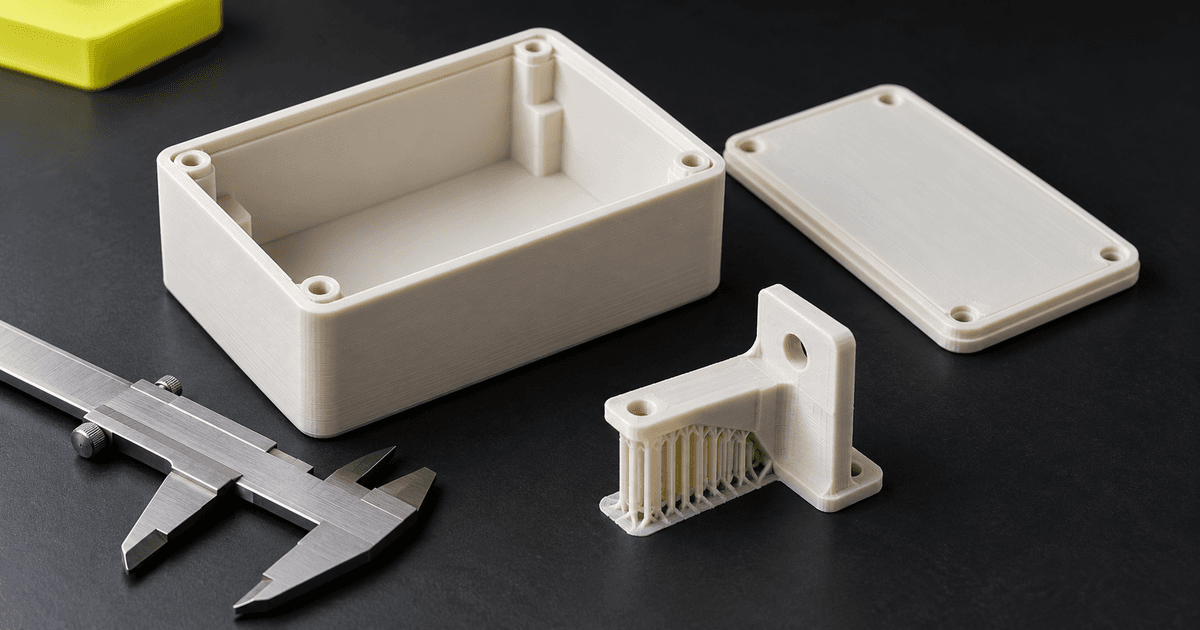
A CAD model that looks complete on screen is not automatically ready for 3D printing. A useful production review considers what the part must do, which additive process may suit it, how it could be oriented and supported, and which features must fit, move, fasten or remain visible.
There is no single set of design rules for every printed part. Suitable geometry depends on the process, material, machine, orientation, finish and acceptance requirements. General guidance can identify questions, but the final design still needs review against the actual production route.
Begin with the part's purpose
Define the decision or task the part must support. A visual model, a fit check, a handling prototype, a fixture and a repeat production component place different demands on geometry. Identify what must be representative and what can remain simplified before spending effort on details that do not affect the result.
- Describe the intended use and who will handle the part.
- Mark critical faces, dimensions, holes and mating features.
- Explain loads, movement, fastening and expected environment.
- Identify visible surfaces and acceptable support or layer marks.
- State whether the part is a prototype, a master, a fixture or an end-use candidate.
- Give the quantity, required date and likely revision path.
Choose the process before fixing every detail
FDM and resin printing form parts differently and can favour different feature, support and finishing decisions. A feature that is straightforward in one orientation or process may be awkward in another. Keeping the design flexible during process review can avoid rebuilding detailed geometry around an assumption that later changes.
Treat orientation as a design decision
Orientation affects how layers follow the shape, where supports contact the part, which surfaces face the build platform and how the part is packed into a production run. It can also influence the behaviour of a loaded feature. If one face, axis or interface is especially important, identify it before the production orientation is selected.
Design supports and access together
Overhangs, bridges, enclosed spaces and deep recesses may need support or a different orientation. Support material must also be removed, so access after printing matters. A support strategy that reaches a hidden cavity but cannot be removed cleanly is not a complete production plan.
Consider whether changing an angle, opening a recess, dividing the part or moving a visible face could reduce support contact. Splitting a model can help, but it introduces joints, alignment and assembly work, so it should solve a defined problem rather than become a default rule.
Give walls and transitions a clear purpose
Wall sections should reflect what the feature needs to achieve: enclosure, stiffness, flexibility, location or visual form. Abrupt changes, narrow roots and isolated projections deserve review because load and handling can concentrate around them. Smooth transitions or local reinforcement may help in some designs, but the correct change depends on the process and function.
Review holes, pins and fastening features
Holes and pins are often functional rather than decorative. Their orientation, surrounding material, access and intended fastener all matter. Decide whether a feature will be printed to final intent, finished afterwards, paired with an inserted component or used only for a prototype check.
Threads, clips, hinges and press features need the same context. State how often they will be assembled, which component they meet and what failure would look like. A familiar CAD feature should not be assumed to behave like its conventionally manufactured equivalent without review.
Design interfaces around fit, not nominal dimensions alone
Two bodies that meet perfectly in CAD have no allowance for manufacturing variation, surface texture, movement or assembly. Describe whether the interface should slide, locate, clamp, rotate or remain separated. The required fit can then be checked through process knowledge, representative samples or an intentional test feature rather than a universal clearance value.
Plan assembly and post-processing
A larger design may need to be divided for production, maintenance or delivery. Define how sections locate, how loads cross the joint and how the assembler can reach each fastener or bonding area. Also protect features that must remain clear during support removal, cleaning, curing or other agreed finishing work.
Identify appearance requirements early
Mark the faces that will be seen, touched, photographed, painted or used as references. Layering and support contact can appear differently across a part, and some details may become less clear after finishing. Describing the purpose of the finish is more useful than asking for every surface to be treated identically.
Use prototypes to answer named questions
A prototype is most valuable when it answers a specific question. A reduced section may be enough to check a clip, hole pattern, interface or support-sensitive feature before producing the complete design. Record what the trial represents and what it does not, then keep the approved revision separate from later changes.
Check the production file and revision
Before release, confirm scale, closed geometry, intended wall sections, duplicate bodies, intersections and the current revision. Identify critical dimensions in supporting information rather than expecting a mesh file to communicate design intent by itself. If CAD development is still underway, separate design approval from production approval.
Before committing to production, make sure the file and brief explain the important features, assumptions and acceptance points. Detail is useful when it helps someone understand how the part must function and how it will be made.
Next steps